
From slaughtering animals to nature conservation: the Třeboň Region House of Nature is to be built on the site of the former abattoir

Published
Houses of Nature are an integral part of the nature and landscape conservation system in the Czech Republic. Every protected landscape area has such a centre, and the Třeboňsko Protected Landscape Area is no exception. The existing House of Nature on the castle grounds was closed this year for operational reasons until 30 June 2026; thanks to this project, Třeboňsko will gain a new House of Nature in completely new premises.
The Slaughterhouse: Then and Now
On the outskirts of Třeboň lies the site of the former slaughterhouse, an architecturally and technically interesting historic building dating from the early 20th century. Animals were slaughtered here until 1990, when the facility was closed for hygiene reasons. Today, a large part of the buildings is in a state of disrepair. It is here that the Třeboň Region House of Nature will relocate in the coming years. The site is owned by the Czech Otter Foundation, which runs the Vydra Eco-Centre here (Vydra means Otter in Czech); an integral part of this is also a wildlife rescue centre.
Next to the wildlife rescue centre
A wildlife rescue centre has been operating on the site of the disused abattoir for more than 20 years. “Many visitors find this combination strange. But what else could there be here other than a project dedicated to restoring life and nature? We’re thereby restoring the energies that weren’t exactly positive here before,” comments Klára Černá, director of the eco-centre, with a smile, referring to the paradox that where animals once lost their lives, they are now being saved.
The rescue centre’s main mission is to return wild animals to the wild. Unfortunately, this is no longer possible for some; the public can come and see these animals during opening hours in a special ‘Animals with a Story’ exhibition. In addition to otters, visitors can see, for example, a fox, birds of prey, owls and waterfowl.
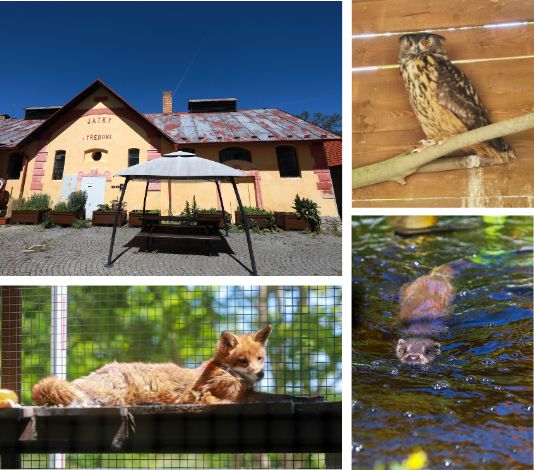
A wildlife rescue centre operates on the site of the former slaughterhouse. The Třeboň Region House of Nature is now set to move there as well.
The operator of the Vydra Eco-Centre, the Czech Otter Foundation, is also the project manager for a project aimed at relocating the Třeboň Region House of Nature to new premises. These will be built in the immediate vicinity of the rescue centre, but will be completely separate in terms of operations.
And why is the House of Nature moving at all?
The current Třeboň House of Nature is situated within the grounds of Třeboň Castle. Unfortunately, however, these premises are not entirely suitable for a visitor centre of this type – due to heritage conservation requirements, it has not been possible to adapt the rooms to a layout suitable for a nature centre. There is also a complete lack of outdoor space, as the current building adjoins Třeboň Castle Park.
Furthermore, the current exhibition is now considerably outdated. “The relocation has been planned for a long time, but it is only now that we have managed to secure funding for this project – from the Swiss-Czech Cooperation Programme,” explains Klára Černá, project manager for the relocation of the Třeboň House of Nature.
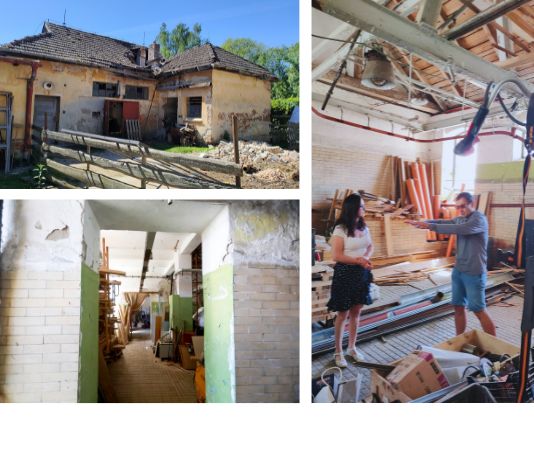
the future premises of the House of Nature
For children and adults alike: a new indoor exhibition and a study room
The conversion of the former slaughterhouse will result in a new indoor exhibition. “We’ll have some educational features for both adults and children,” says Ondřej Novotný, deputy project manager. It was precisely the lack of an exhibition for the youngest visitors that used to disappoint visitors to the original nature centre. “We plan to include items such as tree trunks in the exhibition,” he adds, pointing out that part of the space will remain open right up to the roof trusses, where a viewing gallery for visitors will be created. The House of Nature will also serve as a venue for seminars and school programmes. There are also plans to create a study room and a small cinema. “Unfortunately, however, it will not be possible to preserve all elements of the slaughterhouse’s original industrial interior, as they are not in a good technical condition. They would have to be dismantled, refurbished and reinstalled, which exceeds the financial capabilities of both the project and the contractor,” Novotný regrets.
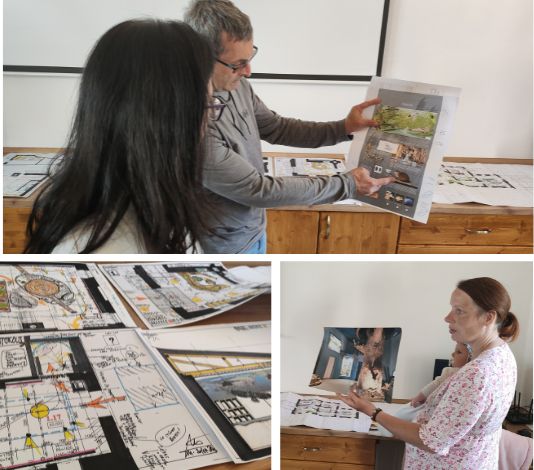
Klára Černá, Director of the Czech Otter Foundation and Project Manager, and Ondřej Novotný, Deputy Project Manager, present plans for the future design of the House of Nature.
Right next to the Zlatá stoka water canal
Another advantage is the location of the new House of Nature – right where it belongs, namely in the countryside. Visitors will be able to enter it directly from the Zlatá stoka water canal, from the main hiking trail leading to the iconic South Bohemian Rožmberk pond.
Another new feature of the Třeboň House of Nature will be an outdoor exhibition with water features, raised flowerbeds, insect houses, bumblebee hives and a sensory trail. Poultry are already roaming the courtyard behind the future House of Nature, which suggests that visitors can also look forward to seeing small domestic animals.
The otter is already being used, the mascot is an eagle
It is tradition for each House of Nature to feature a wild animal in its emblem. In the case of the Třeboň House, given the name of the project’s organiser, an otter would seem a natural choice. However, the mascot of the Třeboň House of Nature has been the white-tailed eagle since its establishment.
This bird of prey returned to the Třeboň region at the end of the last century and has been nesting here successfully and regularly since then. It is therefore a worthy candidate to be the animal symbolising local nature conservation. A permanently disabled female white-tailed eagle, which is in the care of the local rescue centre, can be seen in the nature garden (the future outdoor exhibition of the House of Nature). This brings the imaginary circle linking the two institutions full circle.
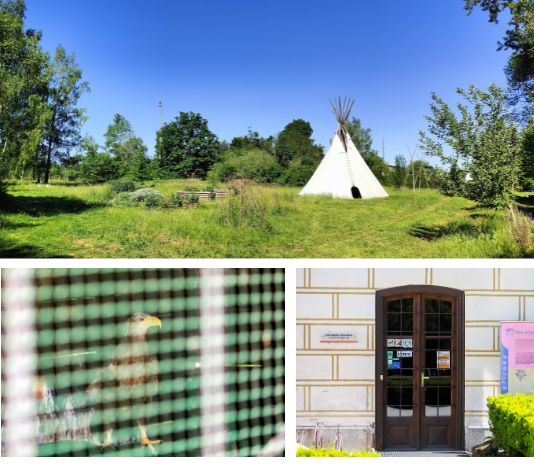
The original House of Nature was closed for part of the year for operational reasons. The new building will be watched over by a female white-tailed eagle, the species that serves as the mascot of the Třeboň House of Nature. Visitors will also have access to an outdoor exhibition, which will be created from the current natural garden.
Sustainable cycling and a visitor counting system
The project aims to promote sustainable tourism in the area. Cycling has become very popular in the region in recent years. This is partly due to the flat terrain of the local landscape, which means the routes are not too demanding. Add to this the beautiful countryside and picturesque ponds, and it is easy to see why the Třeboň region attracts cyclists of all ages, from the youngest to the oldest. The problem, however, is that cyclists are often found in places where they should not be riding – on forest tracks, footpaths and the like. “This problem is often contributed to by private publishers of walking and cycling maps, who label paths as cycle routes without consulting the Protected Landscape Area,” explains Klára Černá.
The project will therefore also focus on creating a visitor map and defining suitable walking and cycling routes across the entire protected area. It aims to collaborate with map publishers and synchronise recommended routes so as to prevent excessive pressure on the valuable natural environment.
A digital guide will also be created to direct visitors along routes that place less strain on the natural environment. “We certainly do not plan to restrict people through bans, but tourists will, for example, earn points in a game for following the correct route with the digital guide,” explains Klára Černá, outlining how it is possible to help combat soil erosion or disturbance to birds’ nesting in a playful and non-coercive way.
When the Nature centre will be ready?
The House of Nature, which will be a modern visitor centre and serve as a link between the Protected Landscape Area and its visitors, is due to be completed by the end of 2028. It is scheduled to welcome its first visitors in late 2028 or early 2029.
Project details:
Project title: Relocation of the Třeboň Region House of Nature
Swiss-Czech Cooperation Programme: Sustainable Tourism and Biodiversity Enhancement
Implementing organisation: Czech Otter Foundation
Project partners: AOPK ČR, Třeboňsko Protected Landscape Area Administration; MAS Třeboňsko, o.p.s., Třeboňsko Tourist Region, z.s.
Total budget: 88,973,500 CZK
Funding from the Swiss-Czech Cooperation Programme: 80,076,150 CZK
Project co-financing (10%): South Bohemian Region; Town of Třeboň, Czech Otter Foundation