
A modern and sustainable national park. In Bohemian Switzerland, we are investing in the future of nature and our visitors.

- ←
- →
Published
Just a few years ago, the area around Hřensko was one of those places that most visitors associated with deep forests, sandstone cliffs and romantic footpaths. However, the summer of 2022 changed that perception. The landscape here has, however, changed dramatically in recent years. In 2018–2019, spruce stands were affected by an overgrowth of bark beetles related to long-term drought and wind disasters. This led to the death of a large part of the adult spruce trees. The fire in the summer of 2022 further accelerated this transformation, affecting approximately 1,300 hectares of forest in the national park and its surroundings. While the first months after the fire were marked by ensuring safety and eliminating the consequences, today the park is looking ahead.
Through the ‘Czech Switzerland: Modern and Sustainable’ project, supported by a grant of over 122 million czech crowns from the Swiss-Czech Cooperation Programme, the national park aims to transform the way people experience and understand the local landscape.
It is not just about new structures or repaired tourist routes. The project combines nature conservation, modern work with visitors, infrastructure renovation and sharing experiences with foreign partners. Its common denominator is the effort to show that even a landscape marked by fire can be a fascinating place full of life. "The project financed by the Swiss-Czech Cooperation Programme is very important for the Bohemian Switzerland National Park. It will help us interpret the natural heritage, manage the flow of visitors and implement a number of activities that will contribute to this," says Petr Kříž, director of the Bohemian Switzerland National Park Administration.
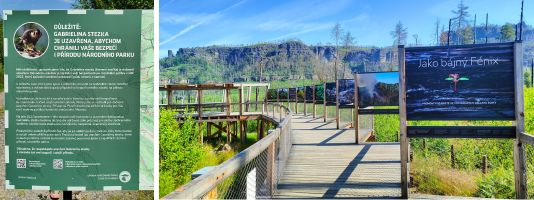
After the fire in the Bohemian Switzerland National Park, the popular Gabrielina stezka trail remained closed. The project includes a study for its restoration. An alternative hiking route leads around the Fénix viewpoint.
A place where people understand why nature should sometimes be left alone
"The most visible part of the project will be the new visitor center at Mezní Louka," explains the director of the national park, continuing to present the project. The center will not serve only as an information point or a base for tourists. The park administration's ambition is to create a place that will explain to people why the national park works differently than a regular commercial forest and why natural changes are an integral part of the life of the local landscape.
The project documentation for the construction is complete and the selection of the contractor will begin in September this year. “If everything goes according to plan, the foundation slab will be laid in the winter of 2026/2027 and the first visitors should enter the center in the summer of 2028,” says project manager Miroslav Havel. At the same time, a tender procedure is underway to prepare the project documentation for the indoor and outdoor exhibition.
Explain, not convince
The exhibition will be the main attraction of the entire facility. Visitors will learn why it is important to protect the unique nature of Bohemian Switzerland and why a fire does not have to be followed by immediate human intervention. They will see concrete examples of how forests regenerate themselves, what role dead wood plays, and why fires and other natural disasters are part of the natural development of ecosystems. The goal is not to convince, but to explain. The National Park Administration wants people to leave with a better understanding of why nature conservation sometimes means giving nature time and space.
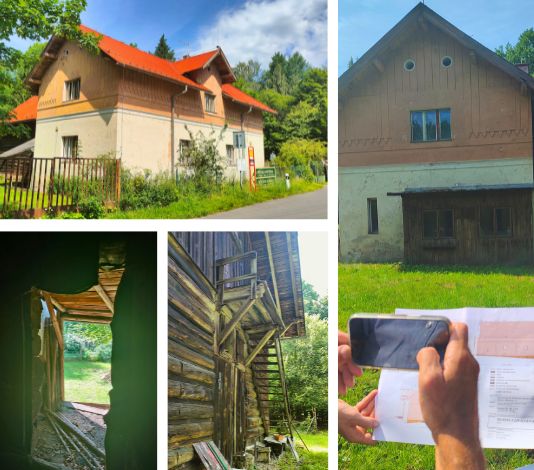
A new visitor center will be built in Mezní Louka.
The Rysí stezka trail will show you a forest that changes before your eyes
The second major pillar of the project will be the extension of the popular Rysí stezka trail (Lynx Trail). “We will significantly expand the Rysí stezka trail, which is a visitor area focused on interpreting natural heritage, especially for children, but of course we also think about other tourists,” says Petr Kříž. The educational area, which is still visited mainly by families with children, will thus be transformed into a living textbook of natural processes.
Part of the newly created trail will be barrier-free and will allow people in wheelchairs or strollers to walk through an otherwise inaccessible area affected by fire and bark beetle disaster. Visitors will be able to watch how the landscape is gradually being restored and how life returns to it. The system of wooden walkways will be expanded, and a new observation tower with a periscope will be created. This has one significant advantage - it can be gradually extended as the young trees grow. This way, the view of the changing landscape will not disappear even in ten or twenty years.
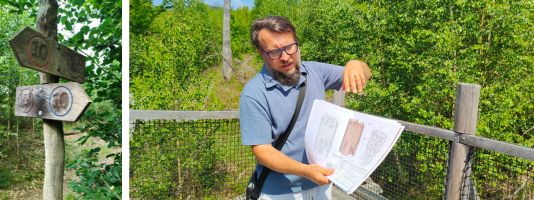
Project manager Miroslav Havel shows plans for expanding the Rysí stezka Trail
Predators and natural processes
Although the name of the trail refers to the lynx, this animal is not permanently found in Bohemian Switzerland. Individual lynxes only occasionally pass through the area. Wolves play a much more important role today. Two wolf families live in the national park, which naturally regulate the number of cloven-hoofed game. Thanks to their smaller size, young trees have a better chance of growing and the forest is being restored faster and more diversely than in the past.
The national park administration also wants to present this story – the return of natural processes and the role of large carnivores in the landscape – to visitors in a clear, attractive way and with specific examples.
Alternative trail and burnt landscape
The 2022 fire changed not only the appearance of the forest, but also the network of tourist trails. For safety reasons, one of the most famous trails in the national park - Gabrielina stezka - had to be closed. Its restoration is therefore an important part of the prepared project. "The project also includes a study for the restoration of Gabrielina stezka, which was closed for safety reasons after the fire," explains Petr Kříž. Thanks to the project, project documentation will also be prepared for the restoration of tourist trails in the Pravčická brána area, where the number of visitors is highest and the trails are most affected by erosion.
At the same time, a worthy alternative will be created for visitors who, due to the closure of Gabrielina stezka Trail, use new, more southern tourist routes, where they currently have to travel part of the way on asphalt. Thanks to the Swiss-Czech Cooperation Program, a route using the Mlýnská cesta (Mill Road) will be completed, which connects Mezná and Hřensko and will offer a much more pleasant experience of moving in nature and will also increase the safety of visitors, who now have to partly move along the road, which is very busy during the tourist season.
One of the most interesting places along the alternative route is the Fénix viewpoint. The name was given to it by the visitors themselves - it symbolically refers to the mythical bird Phoenix that rose from the ashes. The view of the area affected by the fire today offers a unique opportunity to watch how the seemingly destroyed landscape is transformed into a new, species-rich forest.
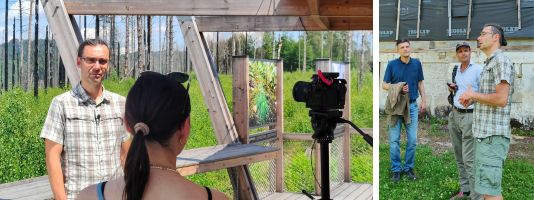
Director of the Czech Switzerland National Park Petr Kříž talks about the Czech Switzerland modern and sustainable Project
It's not just about the consequences of the fire
It is here that visitors can see for themselves that the current appearance of the forest is not just the result of the fire. “For decades, commercial spruce stands dominated the area, gradually replacing the original mixed forests with beeches and firs. These were significantly more resistant to drought, bark beetles and fires,” explains Miroslav Havel.
The current transformation of the forest thus represents an opportunity to return to the landscape the species diversity that was common here in the 19th century. Moreover, history shows that such changes are not exceptional. “At the beginning of the 20th century, the local forests were almost completely destroyed by the nun moths’ calamity,” adds Petr Kříž, director of the national park. Back then, nature also gradually recovered, but the recovery had a distinctly human touch. A large part of the area was once again covered by spruce monocultures, whose vulnerability to drought and bark beetles has become fully apparent in recent years.
Swiss inspiration
However, the project will not only bring new facilities and trails. An equally important part is the international cooperation with the Swiss nature park, which will allow sharing experiences in the care of protected areas between the Czechs and the Swiss. "This project is a great opportunity for the management of the national park to gain foreign experience. We have a partnership with the Binntal Nature Park and we will share experiences not only between our organizations, but also with other partners in the region," says Petr Kříž.
According to project manager Miroslav Havel, the cooperation will focus primarily on areas that are currently addressed by most European protected areas. These include efficient visitor management, working with local residents, and finding joint solutions with municipalities, entrepreneurs, or non-profit organizations. Sharing experiences can help find a balance between protecting exceptionally valuable nature and the growing interest of tourists in visiting Bohemian Switzerland.
In addition to professional seminars and workshops, regional partners will also be involved in the project so that inspiration from abroad is reflected in the daily functioning of the entire area. A Project Council - advisory body of the national park administration - was established to manage the project and communicate its activities (details below). The goal is not only to adopt best practices, but to adapt them to the conditions of Bohemian Switzerland and create a system that will work in the long term for the benefit of nature and local residents.
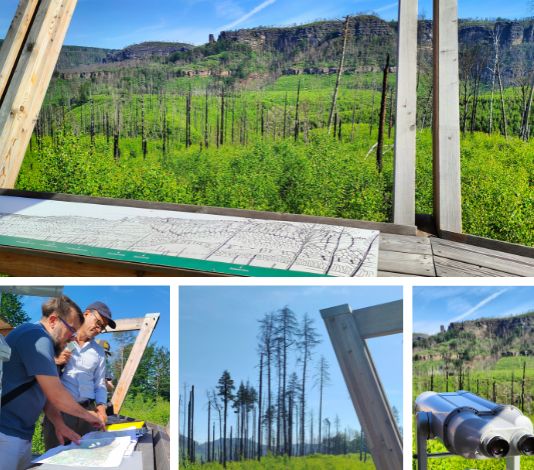
The project will also include the completion of an alternative yellow-marked tourist trail leading along the so-called Mill Road (Mlýnská cesta). From here you can see the Pravčická brána, the burnt landscape and the location of the Gabrielina stezka Trail, closed after the fire.
An investment that makes sense even in decades
The Bohemian Switzerland modern and sustainable project is not just a reaction to the events of recent years. It is above all an investment in the future of one of the most valuable natural areas of the Czech Republic.
The new visitor center will help people better understand the functioning of the national park. The expanded Lynx Trail will show the transformation of the forest live. The care of the tourist routes will allow for safer and more comfortable movement of visitors, and international cooperation will bring inspiration on how to protect nature in times of increasing tourist interest.
The 2022 fire left a deep mark on the landscape. At the same time, however, it reminded us that nature has an extraordinary ability to regenerate. Young broadleaf trees, the return of animals and the gradually changing forest today prove that life is returning to the landscape faster than many could have imagined.
The Bohemian Switzerland National Park Administration wants to bring this transformation closer to the public through the project. Not so that people will realize the consequences of the disaster, but so that they understand that even a seemingly ruined landscape can be a symbol of hope. And that the greatest help we can sometimes offer it is patience and respect for natural processes.
Project details:
Project name: Bohemian Switzerland modern and sustainable
Project promoter: Bohemian Switzerland National Park Administration
Project partner: Landschaftspark Binntal
Total budget: CZK 135 572 40,36
Funding from the Swiss-Czech Cooperation Programme: CZK 122 015 161,22
Programme: Sustainable tourism and strengthening biodiversity
Project web: https://www.npcs.cz/ceske-svycarsko-moderne-udrzitelne
Project Council: The Council is led by the Director of the National Park Administration, who also coordinates its connection with the Swiss partner Landschaftspark Binntal. Members include representatives of local governments (Hřensko, Janov, Ústí nad Labem Region, Děčín City Hall), non-profit organizations (KČT - Czech Tourist Club, České Švýcarsko o.p.s., Horský spolek pro České Švýcarsko, z. s.), the Saxon National Park, local entrepreneurs in accommodation and guide services, and experts in socio-economic aspects, sustainable transport, operation of visitor centers, and nature conservation from universities. The Council shares professional experience, recommends adjustments to activities, and transmits information about the project to municipalities, partners, and the public.